Finding the Source of Recurring Seepage in Apartments
Why seepage and efflorescence return after repairs in apartment buildings, how engineers trace the water path, and what a lasting repair requires.
October 22, 2026
A damp patch is repaired and repainted. A few months later the stain is back. When the same defect returns in several apartments of one building, the problem is rarely the finish. Water is getting in somewhere, and the repair is treating the symptom.
What efflorescence tells you
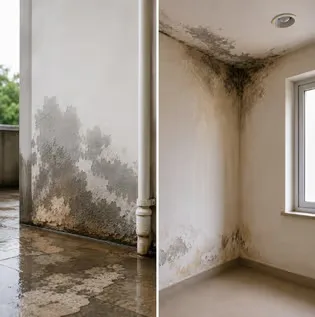
Efflorescence is the white, crystalline deposit that appears on concrete, plaster and tiles. It forms when water passes through a material, dissolves salts inside it and leaves them on the surface as it evaporates. It is not harmful in itself, but it is evidence: water has been moving through that element. Where the deposit appears and how heavy it is gives the first clues about the path the water takes.
How the investigation works
The investigation starts with a survey of the affected apartments. We record where the defects are, how far they extend and whether they repeat in the same position from floor to floor. A pattern that lines up vertically points to a shared source, such as a riser, a shaft or a waterproofing detail repeated on each level.
The next step is to follow the possible water paths: bathroom and kitchen waterproofing, floor drains, pipe penetrations, joints in the building envelope and condensation from air-conditioning. Each one is checked against what was found on the walls and floors until the source that explains the pattern is found.
Why the cause matters
Once the source is known, the repair can be aimed at it. That ends the cycle of cleaning and repainting the same surfaces. We carried out this kind of investigation at Avalon Tower and at a waterfront residential building in Dubai.
Common sources of recurring seepage
Failed wet-area waterproofing: damaged or poorly detailed membranes in bathrooms, kitchens and balconies, often around upstands and thresholds.
Penetrations and drains: gaps where pipes pass through slabs and walls, and floor drains that are not properly sealed into the waterproofing.
Leaking pipework: small leaks in supply or drainage lines hidden inside walls, ceilings and shafts.
The building envelope: rain or irrigation water entering through facade joints, window frames and parapets.
Condensation: poorly insulated chilled water pipes, ducts and condensate drains, which can look exactly like a leak.
Groundwater: water entering basements through joints and cracks, as in the basement leakage assessment at Diamond Tower in Dubai.
Tests that separate one source from another
Depending on the building, the engineer may use moisture mapping, thermal imaging, controlled flood tests of wet areas, pressure tests of water lines and dye tests of drains. Each test isolates one possible source so that the result points clearly in one direction. Opening up selected finishes then confirms what is happening behind them.
When seepage is more than a finish problem
Repeated moisture can damage more than paint. Water carrying chlorides can corrode reinforcement, and rust staining, cracking or spalling concrete call for a structural check, not another cosmetic repair. Mould also affects occupants' comfort and health. For that reason, a seepage investigation may lead to a wider engineering assessment of the building.
What a lasting repair includes
A lasting repair removes the affected finishes, corrects the source, and tests the repaired area before anything is covered up. The substrate is then allowed to dry before finishes are reinstated. Keeping a record of each location, cause and repair helps the building owner to spot any future pattern quickly.
Frequently asked questions
Is efflorescence itself dangerous?
No. The deposit is not harmful in itself, but it shows that water has moved through the material, so the source is worth investigating.
Can seepage be fixed without removing tiles?
Sometimes. Local sealing or injection may work when the source is small and clearly identified, and the result should be tested. A widespread waterproofing failure usually requires removing the finishes.
Who should commission the investigation?
Usually the building owner, developer or facilities manager. An independent investigation before repairs are priced means contractors can quote against a known cause.
Our assessment and consultancy services are listed under engineering and design. Dealing with a defect that keeps coming back? Tell us what you are seeing and we can advise on the next step.
Share this article
If you found this article helpful, share it with others